
Brass Jewelry Supplier Vetting: Six Questions
Most supplier vetting fails because it asks about price and quality in the same breath. Six questions do more work: what the minimum is, how long sampling takes, which steps the factory owns, what the plating stack is, who inspects the batch and what happens on a repeat order. The published answers from TTT Jewelry are 100 pieces per design in eco-brass, a 25–30 day sampling window and 100% inspection before packing.

Key takeaways
- Minimums run 100+ pieces in stainless steel, 50 pcs in 925 silver and 100 units in eco-brass, for each design, with each design counted separately.
- Ask for the sampling and production windows in the same reply, since 25–30 days plus 3–4 weeks sets the date.
- Ask which of the eight published steps happen in-house, and which are subcontracted.
- Ask who signs the 100% inspection, then ask for the same document on the repeat order.
Question one: what exactly is the minimum, and per what?
The MOQ is only meaningful with a unit attached. Floors are 50 in stainless steel, artisan brass with recycled content and 925 sterling silver, design by design, and they hold design by design. A supplier that quotes a single flat minimum for all three materials is quoting a policy rather than a production constraint.
The follow-up matters as much as the answer. "Per design" means each shape carries the floor, so a five-design brass range starts at 500 pieces. If the number turns out to be per order rather than per design, the tooling assumption behind it is different and so is the price you will eventually be given.
Question two: how long is sampling, and what is inside it?
Master sampling is quoted at 25–30 days, and the five operations inside it are wax printing in 3D first, then casting in a precision mould, stone-setting, polishing and electroplating to spec. Production after approval is 3–4 weeks, and 3D CAD is under 48 hours for the drawing and render you sign off on.
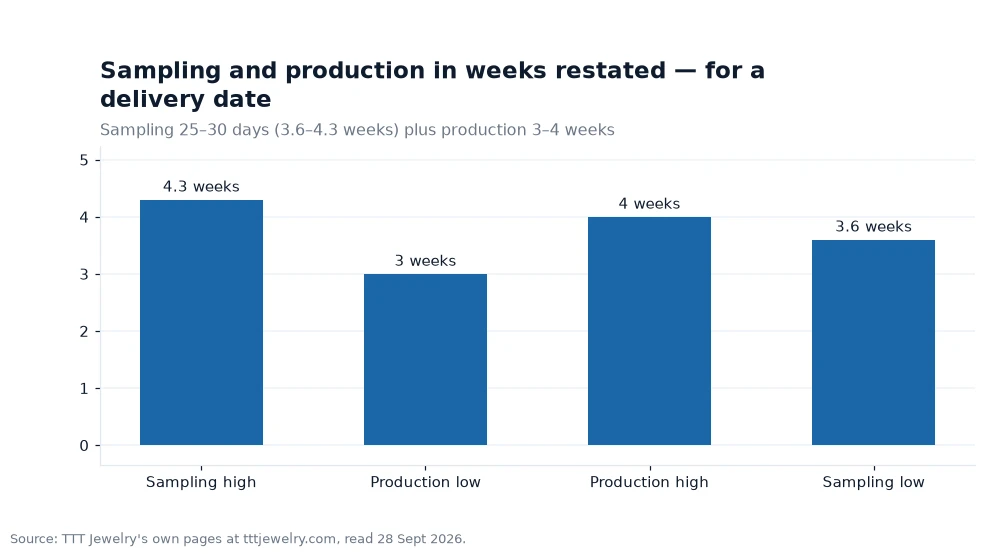
A supplier who can name the operations is describing a floor. A supplier who gives one number and no breakdown is asking you to trust a date rather than a process, and the breakdown is also what lets you see where time goes if the order runs late. Converting the windows helps: 25–30 days is 3.6 to 4.3 weeks, and 3–4 weeks of production sits on top.
| Question | The published answer | What a vague reply tells you |
|---|---|---|
| Minimum per material? | 50 silver / 100 brass / 100+ stainless, per design | The tooling floor is not understood |
| Sampling window? | 25–30 days over five named operations | The process is not broken into stages |
| Which steps are in-house? | Eight documented steps, sprue cutting included | Work may be bought in and resold |
| Plating stack? | 14K / 18K / 24K gold or rhodium, plus e-coating | Finishes may be traded out |
| Who inspects? | 100% inspection before packing and delivery | Inspection may be a sample |
Question three: which of the eight steps do you own?
The published sequence runs concept design, prototyping, sprue cutting, polishing, surface art, electroplating, final inspection and delivery. Sprue cutting is the tell. It is the stage where the feed channels left by casting are trimmed off, and a reseller will not have an answer about it because there is nothing for them to trim.
Ask which of the eight are subcontracted and you get a map of risk. A factory that plates in-house but sources castings elsewhere has a different failure mode from one that does everything under one roof, and neither is automatically worse — but you should know which one you are buying before a launch depends on it.
Question four: what is the plating stack, in order?
Finishes run rhodium plating, an anti-tarnish e-coat applied to silver and brass, stainless steel finished with PVD vacuum plating and multi-layer gold in 14K, 18K and 24K.
Then ask the order-of-operations question: is the coating applied before or after stone setting and engraving? Both operations cut into a finished surface, so a coating applied first is a coating with holes in it. A supplier who can answer this without checking is a supplier who has thought about the joins.
Question five and six: who inspects, and what happens on a repeat?
Final inspection is published as 100% of the batch, before packing and delivery. A sampling plan that checks a percentage of pieces is a different proposition, and it is worth asking for the inspection stage by name. If the answer describes a step after plating and before packing, you are talking to a process; if it describes a feeling, you are not.
The repeat order question is the one that exposes a weak supplier late. On the second order the mould exists, so CAD from the model does not repeat and the sampling block shrinks to a finish or colour check. A supplier who quotes the full 25–30 day window again on a repeat is either re-tooling or padding the schedule, and both are worth knowing before you plan a second drop. This is the point where a buyer should get quote terms confirmed rather than assume the second run will be faster.
What a brass supplier should put in writing
Beyond the windows, five material facts are worth having on file. The alloy is a premium copper-and-zinc blend; nickel content meets certified standards; the line conforms with REACH and California Prop 65; oxidation and antique finishes are available alongside gold and rhodium plating that the page describes as comfortable for most skin types; and the brass is 100% recyclable.
Ask for the inspection description too, because the brass route ends with manual checking of craft, finish, gem setting, size and structure. A supplier who can name those five checks is describing a floor; one who says everything gets looked at is describing an intention. Put that answer next to the sampling window in the same note, so the sample is judged against the same list.
Worked example: the two-week spread between a fast and slow reply
Put the weeks side by side. Sampling at the slow end is 4.3 weeks and at the fast end 3.6 weeks. Production at 4 weeks sits at the slow end and 3 weeks at the fast end. A slow-path order is therefore 4.3 + 4 = 8.3 weeks of factory time, and a fast-path order is 3.6 + 3 = 6.6 weeks, before CAD and before either approval gate.
The difference is 8.3 − 6.6 = 1.7 weeks, which is more than the entire CAD stage by an order of magnitude. That 1.7 weeks is not a saving anyone can be promised in advance; it is the range the factory publishes, and it is the reason a vetting conversation should produce a range and not a single date. My arithmetic; the 4.3, 3.6, 4 and 3 are the published figures.
Frequently asked questions
How many pieces should a first brass order be?
The published floor is 100 pieces per design for artisan eco-brass, so a single-style test is one design at 100 pieces.
What should a supplier be able to prove on request?
The step list, the sampling and production windows, the plating stack, the 100% inspection point and the compliance positions: A BSCI audit, REACH restrictions on lead, cadmium and nickel and ISO 9001:2015 certification, cadmium and nickel.
Why ask about repeat orders during vetting?
Because the second order should be shorter than the first, and a supplier who quotes the full sampling window again is either re-tooling or padding the schedule.
Turning the six answers into a decision
Score the replies rather than the presentation. A supplier who answers all six in one message, with a window given as a range and a named inspection stage, has shown you the process. One who answers with a price and a promise has shown you a sales call. Keep the answers in writing, because the same document becomes the checklist for the sample when it arrives — minimum, window, step list, plating order and inspection point, in that order. If the answers hold up, the next step is a first order rather than a second conversation; the OEM and ODM comparison sets out what changes when you bring your own drawings, and the factory overview documents the eight steps the questions are built around.
Tracked back — the ISO 9001:2015, BSCI and REACH statements, the gold and rhodium plating layers plus the recyclable-brass statement — every one of them came from the brand's own pages over at tttjewelry.com, as of 28 Sept 2026. The custom brass jewelry line is where the oxidation and antique finishes appear. Custom brass jewelry work is quoted on the same pages as the rest of the range. The sums behind the example are mine alone [1]