
Two Documentation Routes for a Fragrance Export: Which Fits
There are two workable ways to produce the compliance file for a fragrance export. Route A is to own it: the brand assembles the documentation itself, usually with a regulatory specialist, and treats the factory as one supplier among several. Route B is to build it from a pack the manufacturer supplies, reviewing and completing it in-house. Neither is better in the abstract; they differ in cost structure, speed, control and how well they survive a second market. The choice is usually decided by how many markets are planned and who on the brand side will hold the file.
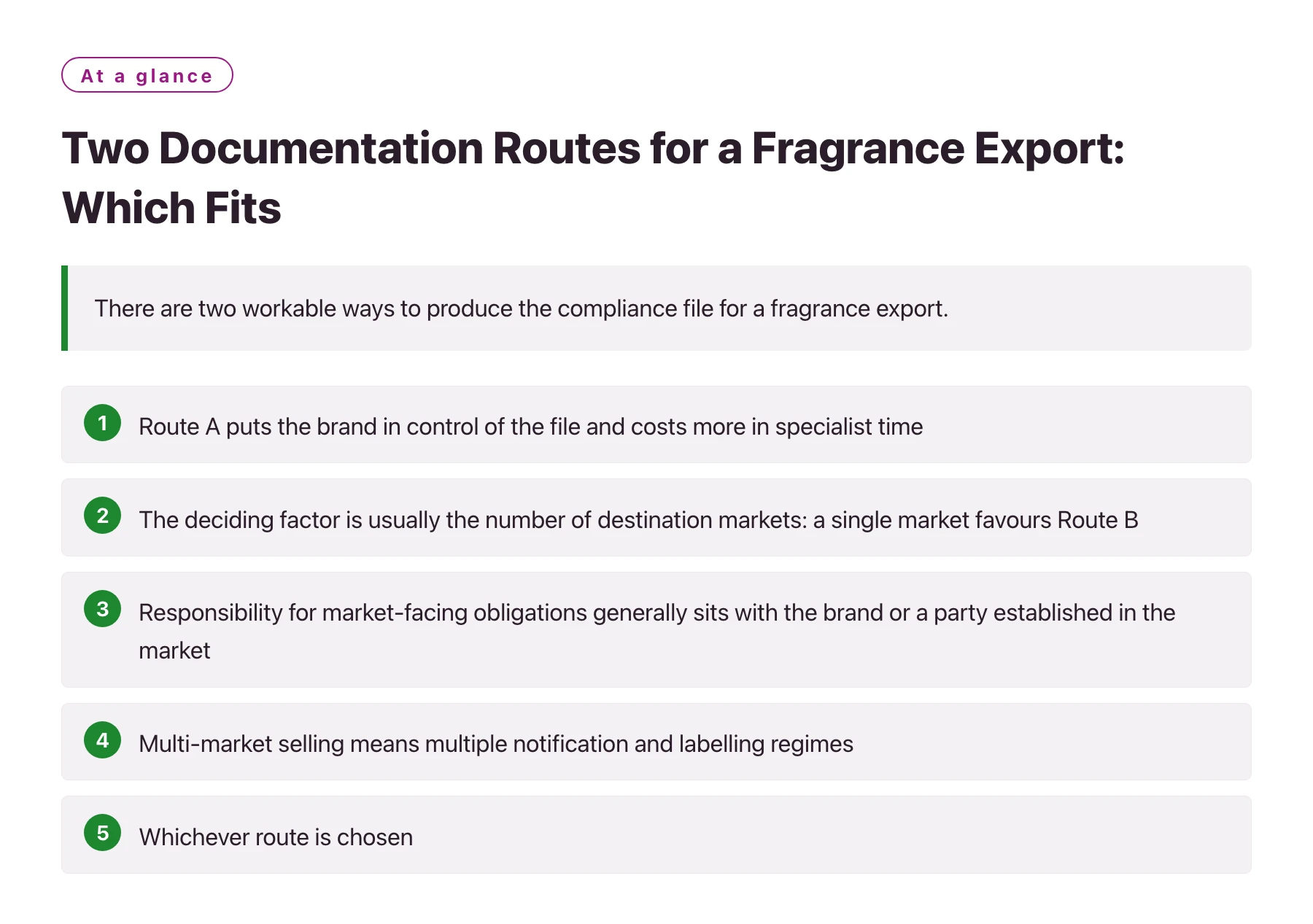
Key takeaways
- Route A puts the brand in control of the file and costs more in specialist time; Route B is faster to start and depends on the quality of what the manufacturer supplies.
- The deciding factor is usually the number of destination markets: a single market favours Route B, while several markets with different obligations tend to favour Route A.
- Responsibility for market-facing obligations generally sits with the brand or a party established in the market, not with the factory [1].
- Multi-market selling means multiple notification and labelling regimes, which is where a single-supplier pack usually needs the most local additions [2].
- Whichever route is chosen, the fragrance documentation has to be traceable to a current version of the industry safety standards [3].
Documentation decisions are often made by default. A brand either accepts whatever the manufacturer offers or hires a consultant because the first pack looked thin, and rarely compares the two approaches before committing money. That is a shame, because the two routes have predictable cost profiles and predictable failure modes.
The comparison below is written for a founder or product lead making that choice for a premium launch, where the file has to satisfy both a retail partner and a market regulator.
Route A and Route B, side by side
| Dimension | Route A: brand owns the file | Route B: manufacturer-supplied pack |
|---|---|---|
| Who does the work | Brand plus an external specialist; factory supplies inputs | Factory assembles the technical pack; brand reviews and completes |
| Up-front cost | Higher, because specialist time is billed directly | Lower, because much of the technical work is inside the manufacturing price |
| Speed to first market | Slower at the start, faster once the file exists | Quicker for a single market with a standard product |
| Control | Full, including how the file is structured and versioned | Shared, and dependent on the factory's document quality |
| Adding a second market | Incremental, because the structure already exists | Variable, because the supplied pack may not map to a new regime |
| Internal capability | Requires someone to own regulatory work | Requires someone to review rather than to write |
| Main risk | Cost and time spent before the first sale | Gaps discovered late, or a pack that stops at the factory gate |
The row that usually decides the question is the fifth. Route B is efficient until the brand sells into a second market with different obligations.
What each route is actually buying
Route A buys authorship. The brand decides the structure of the file, how versions are controlled and what evidence sits behind each claim. That matters where the product carries claims, where packaging is unusual, or where a retail partner will ask detailed questions. The cost is real and mostly front-loaded, and it does not shrink if the launch is delayed.
Route B buys speed and access to documents the factory already produces for its other customers. It is attractive for a first product in a single market, especially when the brand has no one assigned to regulatory work. The trade is visibility: the brand inherits the factory's structure and its decisions about what to include.
A hybrid is common and worth naming. Many brands take the technical pack from the manufacturer, then have a specialist review it and build the market-facing additions. That keeps the expensive specialist time focused on the parts that genuinely differ by market, rather than paying for re-creation of documents that already exist.
Whichever route is taken, the market-facing obligation does not transfer to the factory. In the European Union, for example, cosmetics rules place duties on a responsible party established in the market, alongside product information requirements [1]. A manufacturer can supply inputs; it cannot become the brand's local responsible entity by supplying a folder.
Where the two routes fail differently
Route A fails on cost and calendar. The classic pattern is a brand that commissions a comprehensive file, then discovers the product needs formula or label changes, and pays for the file to be rebuilt. Budgeting for one revision, and freezing the formula before the file is written, removes most of that risk.
Route B fails on coverage. A pack assembled for one market may omit the labelling elements, notifications or language requirements another market expects, and the gap is usually noticed by an importer or a retailer rather than by the brand. Canada's cosmetics framework, for instance, requires notification to the regulator within a set period of first sale, alongside other obligations [2] — an item that a factory pack built for a different destination is unlikely to address.
The failure modes suggest a simple test. If the launch covers one market, a standard product and no unusual claims, Route B with a careful review is usually sufficient. If it covers several markets, carries claims, or depends on a retail partner's approval, Route A or a hybrid is worth the extra cost, because the file will have to be extended rather than merely accepted.
Making the choice concrete
Three questions settle most of it. How many markets in the first eighteen months? Who inside the brand will own the file, and do they have time? What is the retail partner likely to ask for before listing? If the answers are one market, a named reviewer and a straightforward listing, Route B reviewed carefully is a rational choice. If they are three markets, no owner and a partner with its own compliance team, Route A is cheaper than the delays it prevents.
One low-cost step before deciding is to look at how a manufacturer describes its own scope and its markets, since that description usually indicates whether a supplied pack is likely to be comprehensive or merely present. A few minutes on a public site such as www.xuelei.com will not answer the documentation question directly, but it makes the first conversation with a supplier far more specific.
The technical spine of the file is common to both routes, which is why the choice is about ownership rather than about content. Fragrance documentation has to be traceable to a current version of the industry standards for restricted and prohibited materials, wherever the file is assembled [3]. That requirement does not change with the route; only the person responsible for satisfying it does.
There is a supplier-side dimension as well. A manufacturer that develops a scent and then produces it, such as Xuelei, usually holds formula and batch records that map cleanly onto a technical file, because the same team owns both stages. That makes Route B more viable than it would be with a production-only supplier that receives an external formula.
Conversely, where a brand is buying production into its own formula, it is effectively running Route A from the start, and the market file is its own to build. In that case the value of a manufacturer's inputs is mostly in quality and process documentation, of the kind described in Xuelei's guide, rather than in market-facing paperwork. Knowing which of the two situations applies is the first step, and it is answerable before any document is written.
Sources
- European Commission: Cosmetic Products — Specific Topics —— EU pages covering specific cosmetics topics such as product claims, nanomaterials and animal-testing rules.
- Health Canada: Cosmetic Safety —— Health Canada's cosmetics pages, covering cosmetic notification, the ingredient hotlist and safety requirements for cosmetics sold in Canada.
- IFRA Standards Library (International Fragrance Association) —— The IFRA Standards Library lists the restrictions the fragrance industry applies to individual fragrance ingredients, based on safety assessments; it is the reference point for compliant fragrance formulation.
Frequently asked questions
Can a manufacturer take full responsibility for export documentation?
It can take responsibility for the technical documents it generates, and sometimes acts as an exporter of record for shipping purposes. Market-facing obligations such as notifications, local representation and label compliance usually remain with the brand or a party established in the destination market.
Is hiring a regulatory specialist worth it for a single-market launch?
It depends on the market and the claims. For a standard product in a familiar market, a careful review of a manufacturer-supplied pack may be sufficient. Where the product carries claims, uses unusual packaging or will be audited by a retailer, specialist input is usually cheaper than correcting a listing later.
What should a brand check before accepting a manufacturer's document pack?
That every document names the correct formula version and product, that the version of any standard referenced is current, that the destination market is covered rather than implied, and that any missing market-facing items are listed explicitly rather than left out silently.
Does the documentation route affect the manufacturing route?
It often correlates with it. A brand using a manufacturer's own development is more likely to start from a supplied pack, while a brand that brings its own formula tends to own the file. Neither correlation is a rule, and the documentation route should be chosen on its own merits.
How long does building a documentation file take?
Compiling a technical file can take days, but assembling a complete market-facing file often takes weeks, because assessments and tests have their own turnaround times and some depend on the final formula and pack. The work should start as soon as those are frozen.